
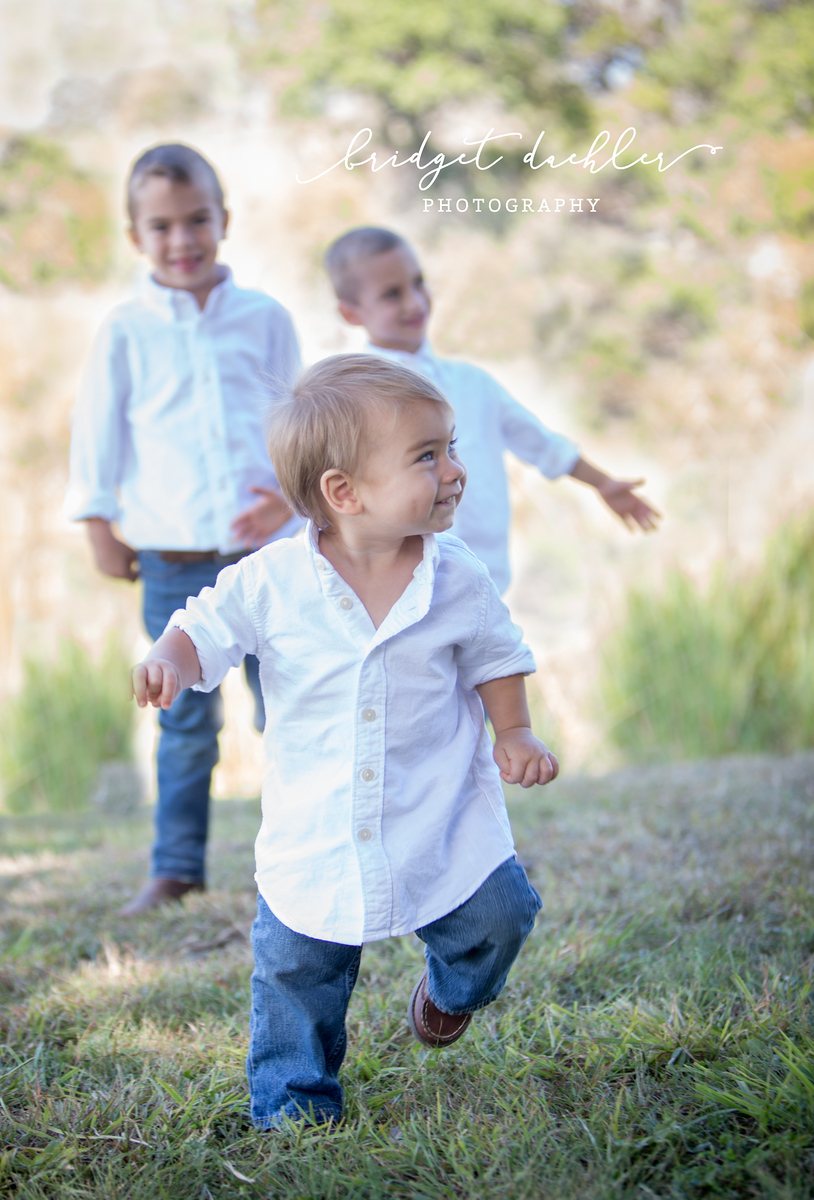
The short answer
Wear soft, mid tone colors in breathable fabrics: cream, sage, dusty blue, rust and warm neutrals photograph beautifully against Texas Hill Country limestone and gold grass. Skip logos, neon and tight patterns. Coordinate your group in one palette instead of matching. In Austin summer, choose linen and cotton over polyester, and book a golden hour session.
That is the short version. What follows is the long version, written for the light and weather we actually have in Central Texas. Bridget Daehler photographs people outdoors, and the single thing that changes a gallery most, more than the camera and more than the location, is what everyone decided to put on that morning.
What are the universal rules that work for every session?
Choose clothes you can move in. Bridget photographs people in their most natural state: walking, sitting on limestone, turning toward each other, kids climbing. If a skirt rides up or a collar chokes, it shows on your face in every frame. Sit, stand, hug someone, walk ten steps, then decide.
Fit beats price. A $30 shirt tailored to your shoulders photographs better than a $300 shirt that gapes, because cameras exaggerate excess fabric.
Go one shade softer. Color reads more saturated on camera than in your closet, and a nice medium blue indoors turns electric in direct Texas sun.
Layers add depth. A cardigan, an open chambray shirt, a jacket, a hat: dimension plus outfit changes without a full change.
Texture does what pattern cannot. Linen slubs, cable knits, corduroy, raw denim, eyelet and suede photograph with depth and never fight the face.
The eyes win. Bridget's work focuses on the eyes and the story. If someone sees your shirt before your face, the shirt lost you the picture.
Which colors photograph best in Texas Hill Country light?
Our backdrops are limestone, live oak, cedar and juniper, near white caliche roads, native grass that is gold most of the year, and a sky often bleached pale by heat. That environment rewards muted, earth adjacent color and punishes a fluorescent base.
The core Hill Country palette:
- Warm neutrals: cream, ivory, oatmeal, bone, camel, tan, taupe
- Muted greens: sage, olive, eucalyptus, moss
- Dusty blues: slate, French blue, chambray, faded indigo
- Earth reds: terracotta, rust, clay, brick, muted burgundy
- Soft warm tones: blush, dusty rose, apricot, mustard used sparingly
- Deep anchors: charcoal, muted navy, espresso, deep forest
Build a palette in five minutes: pick two neutrals and one accent. Cream and taupe with rust. Oatmeal and charcoal with sage. Everyone pulls from those three in different proportions and textures.
Colors that struggle here: kelly green, hot pink, electric turquoise, bright orange, lemon yellow and true red in full sun. They bounce color onto skin. Wear a bright as an accent, never as the whole shirt.
Match the month, not Pinterest. Central Texas is green roughly March through May and briefly again in October after fall rain. July through September, our grass is gold. A sage dress that sang in April disappears against an October field.
What should you avoid wearing, and why?
Logos, graphics and slogans. A logo dates a photograph instantly and pulls the eye like a magnet. Family portraits hang for twenty years.
Neon and fluorescent. Neon reflects onto skin. A lime shirt in Texas sun throws green onto a jaw and neck, and editing does not remove it.
Tight repeating patterns. Thin stripes, small checks, herringbone and fine gingham create moire, a shimmering distortion that appears when a fine pattern meets the camera sensor, and it is unfixable afterward. If you want pattern, go large scale: a wide stripe, a loose floral, a big plaid.
Head to toe pure white outdoors at midday. The camera exposes for the brightest thing in the frame, which leaves faces dark. Cream, ivory and bone read as white to the eye and hold detail beautifully.
Head to toe black outdoors. Black loses detail in shadow and becomes a shape, and in a group it fuses people into one dark mass. Charcoal, espresso and deep navy keep texture.
Shiny synthetics and brand new shoes. Satin, sequins, high gloss polyester and metallics catch highlights that blow out to pure white and trap heat. Unbroken shoes hurt on limestone and gravel, and you wear that discomfort on your face.
What fabrics survive an Austin summer session?
Austin averages roughly 209 days a year at 80 degrees or warmer, about 123 days in the 90s and around 29 days at 100 or above, with humidity averaging 67 percent and running near 84 percent at 6 a.m. You will sweat. Fabric decides whether the camera sees it.
Wear: linen and linen blends, cotton lawn, cotton voile, chambray, seersucker, gauze, tencel and natural fiber jersey. All breathe, and most read as soft and expensive on camera.
Avoid June through September: polyester, nylon, thick ponte, head to toe heavy denim, leather, velvet, corduroy and anything lined.
Sweat and color: heather gray, light blue and pale pink show underarm and back sweat fastest. Cream, camel, rust, olive and prints hide it best. In July and August, choose a print or a mid tone over a pale solid, and book the last ninety minutes before sunset rather than midday.
What should you wear for senior portraits?
Bring three or four looks: one casual and genuinely you (jeans and a soft tee, a favorite jacket), one elevated (a dress, a jumpsuit, a blazer over a tee), one textured or seasonal (a knit sweater in November, a linen set in May), and one that means something (letterman jacket, team jersey, marching band uniform, boots, an instrument, a first car). That last one is what graduation announcements get built around.
Solid tops beat busy ones, because senior galleries are shot close and the face is the subject. Skip strapless if you want a wide range of poses, and bring walking shoes plus photo shoes. Most Central Texas seniors shoot between late May and early October, so a summer date means linen, cotton and a sunset start.
How do you coordinate a family or group without matching?
Start with the person whose outfit is hardest to find, often mom or the oldest daughter. Build it first, pull three to five colors out of it, then dress everyone from those colors.
A worked example, family of five, October near Austin: Mom in a rust and cream floral midi. Dad in a cream linen button down and espresso chinos. Oldest in an olive corduroy dress. Middle in a cream sweater and dark denim. Youngest in rust overalls over an oatmeal tee. One palette, nobody identical.
- One patterned piece per three or four people. More than that gets noisy.
- Vary your value range. Mix light, mid and dark so people separate in the frame.
- Whoever wears the lightest color draws the eye. Place that tone deliberately.
- Coordinate shoes. Neutral boots, white sneakers across the board, or bare feet on a riverbank.
- Pack a backup shirt for the toddler in the same palette.
Bridget's weekday family session is $350 with 4 edited images. The weekend sunset session is $500, covers up to 7 family members and includes 8 edited images. Additional image files are $50 each. Confirm group size before you finalize outfits, because a nine person palette is planned differently than a four person palette.
What should you wear for engagement photos?
Two outfits. Relaxed: jeans, a soft neutral top, boots or clean sneakers for him; a flowing midi or a knit top and denim for her. Most save the dates come from this one.Dressed up: a long dress with a full skirt or a fluid slip cut that moves in Hill Country wind, paired with a jacket or linen suit rather than a tuxedo. Coordinate as a couple, not as twins: if she wears dusty blue, he wears cream, oatmeal or camel.
Wind is guaranteed on any bluff overlook, so bring a hair tie and pins. Clean the ring the day before and choose a neutral or sheer polish so it does not compete with the stone. Full location detail lives in the engagement photos guide.
What should you wear for a headshot?
Headshots are shot tight: your face, your neckline and about six inches of shoulder. Every decision happens in that small area.
Choose solid, mid tone colors such as charcoal, navy, forest, burgundy, slate blue, camel or cream, avoiding the exact color of your background or your own skin tone. Necklines carry the message, so bring at least two: a crew, a v neck, a collar, a blazer over a shell. Structure at the shoulder reads as authority. Iron everything, because wrinkles are brutal at this distance, and keep jewelry small.
What should you wear for maternity photos?
Show the shape, do not hide it. Fitted through the bump and flowing everywhere else: a jersey or ribbed knit dress that hugs the belly and drapes at the hem. Long dresses and sleeves elongate the body, and solids beat prints, because a print stretched over a bump distorts. Bring a simpler second look, such as a partner's button down open over a fitted neutral tank. Most mothers photograph between 30 and 36 weeks; in summer, book the early end of that window and go at sunset. Skip stiff waistbands and heels on uneven ground.
What should you wear for a commercial or branding session?
Start with your brand's actual colors so your wardrobe sits next to them without clashing, and dress one notch above your customer: a contractor in a clean work shirt, an advisor in a blazer, an instructor in premium athletic wear rather than a free race tee. Bring three tiers: working, professional and relaxed. Web headers crop wide and Instagram crops square, so leave visual room, keep busy pattern off the neckline, and favor solids if headline text will sit over the image. For a team shoot, put the palette and formality in writing a week ahead.
What should you wear for a social media content day?
A content day is a wardrobe marathon: weeks of posts in one session. Bring five to eight looks, each a different week of content, and vary formality on purpose: two elevated, two everyday, one working, one seasonal. Change one strong element per look (jacket on or off, hair up or down, a different accent color) so images do not blur together, bring real props, and order the looks by formality so you spend session time shooting instead of changing.
What should you wear in each Texas season?
Spring and bluebonnet season, March and April. Bluebonnets bloom roughly early March through late April in Central Texas, peaking most years in late March and early April. They read blue violet against green grass, so navy and royal blue vanish into them. Wear cream, white, blush, soft yellow, warm tan, pale pink or sage, and choose a long dress that skims the flowers.
The real rules: picking bluebonnets is not illegal across most of Texas, since the old statute was repealed in 1973, but removing plants inside a state or national park is prohibited, and private land requires permission. Highway shoulders carry genuine safety risk, so Bridget works on managed public land instead. Muleshoe Bend Recreation Area on Lake Travis in Spicewood is an LCRA park known for its bluebonnet fields: open sunrise to sunset, $5 per adult, free for children 12 and under, $2 for seniors 65 and up, military and visitors with disabilities. Sit or kneel between the flowers, never on them.
Summer, June through September. Austin's early August average high sits near 99 degrees with overnight lows near 76. Book the last ninety minutes before sunset: in late June that means starting close to 7:00 p.m., since Austin's latest sunset is 8:37 p.m. on June 30.
Fall, late October through early December. Central Texas color arrives late. Bald cypress along Onion Creek at McKinney Falls and along the San Gabriel River in Georgetown turn rust and copper in November. Wear mustard, burgundy, camel, forest and espresso, and bring a real layer, because November temperatures drop fast after sunset.
Winter, December through February. Austin's coldest stretch averages a high near 62 degrees and a low near 41, and sunset is earliest on December 3 at 5:31 p.m., so winter sessions start mid afternoon. Wear wool, cashmere, flannel, chunky knits and a coat you actually like, in cream, camel, charcoal, forest and burgundy. Gold winter grass makes warm neutrals sing.
What should men wear? (the section most guides skip)
Men get one sentence in most what to wear guides. Here is the real version.
Fit is the entire game. The shoulder seam sits on your shoulder bone, not below it, and sleeves end at the wrist bone. A shirt that billows at the waist reads as sloppy even when it feels comfortable. If you own one thing that fits perfectly, wear that.
Best colors in Hill Country light: olive, oatmeal, cream, camel, chambray blue, slate, espresso, charcoal, muted burgundy and deep forest. Avoid true black outdoors, bright white dress shirts at midday, and any visible brand mark.
Best pieces: a linen or cotton button down with sleeves rolled twice to just below the elbow, a well fitting henley, a merino crewneck in fall and winter, dark straight leg denim without distressing, stone chinos, and an unlined blazer for the elevated look.
Shoes: clean leather boots, suede chukkas or clean white sneakers. Not runners with neon accents, not the shoes you mow in.
Grooming: haircut 7 to 10 days out so it looks lived in. Trim the beard line, neckline, nose and ear hair the morning of, because outdoor side light finds everything. Matte product beats shine in humidity.
Undershirts: wear one that never peeks at the collar, or skip it. A visible undershirt collar is the most common fixable problem in men's portraits.
Summer: linen or a linen blend, and short sleeve camp collar shirts photograph well. No polyester polos in July, because they shine and hold sweat.
When should you schedule hair and makeup?
Book a haircut or color 7 to 14 days before, never the day before, so it settles and any color evens out. Schedule professional makeup to finish 60 to 90 minutes before your start time. Ask for a soft matte finish with no SPF in the foundation or powder, since titanium dioxide and zinc oxide can cause flashback, a white cast on skin, any time a flash is used. Blot rather than powder in Austin humidity, and bring your exact lip color. Nails matter for engagement and maternity sessions, where hands and rings are photographed close.
What should you bring, and what does the printable checklist look like?
Pack this bag: lint roller, safety pins, hair ties and bobby pins, blotting papers, your exact lip color, a hairbrush, water, dye free snacks if kids are coming, walking shoes, a towel, bug spray April through October, backup clothes for anyone under six, sunscreen applied 20 minutes ahead, and a jacket November through February, because a creek bottom at sunset is much colder than the parking lot.
Two weeks out
- Pick your palette: two neutrals plus one accent
- Confirm session type, location and group size with Bridget
- Book haircut or color, and order anything you need to buy
One week out
- Lay every outfit out together and photograph them as a group
- Check for logos, neon, tight patterns, all white and all black
- Try each outfit on and do the movement test
- Break in new shoes and send the palette to the group in writing
Two days out
- Wash, dry and steam or iron everything
- Clean shoes, jewelry and the ring
- Pack the bag and confirm the meeting spot
Session day
- Eat something real beforehand
- Dress in air conditioning; hang outfits for a long drive
- Arrive 10 minutes early with the bag
Ready to book?
Bridget Daehler photographs seniors, families, couples, babies, professionals and brands in Austin, Dripping Springs, Lakeway, Georgetown, Lake Travis and the surrounding Hill Country. Sessions start at $150, most clients book in the $350 to $500 range, and premium collections run $850 to $1500. Tell her what you want and she will help you pick the date, the location and the outfits.
Call (847) 606-6003 or email daehler.b@gmail.com to check availability.
Contact sheet
Recent frames
Questions
Answers, before you ask
01What colors should I wear for family photos in Texas?
Cream, oatmeal, camel, sage, olive, dusty blue, terracotta, rust and charcoal photograph beautifully against limestone, live oak and gold Hill Country grass. Choose two neutrals plus one accent and let everyone pull from those three.
02Should my family wear matching outfits for pictures?
No. Matching reads as a uniform and flattens individuality. Coordinate instead: one palette, different pieces, different textures, and a mix of light, mid and dark tones so people separate in the frame.
03Can I wear white for outdoor photos in Austin?
Pure white in full midday sun is the hardest version, because the camera exposes for the brightest thing in the frame. Cream, ivory and bone read as white and hold far more detail. For true white, shoot at golden hour or in open shade.
04What should I wear for photos in Texas summer heat?
Linen, cotton lawn, chambray, seersucker, gauze and tencel. Avoid polyester, lined garments, leather and heavy denim June through September, and choose prints or mid tones over pale solids, since heather gray and light blue show sweat fastest.
05What should I wear for bluebonnet photos?
Bluebonnets read blue violet against green spring grass, so navy and royal blue disappear into them. Cream, white, blush, soft yellow, warm tan and pale pink separate beautifully. They bloom roughly early March through late April.
06What should men wear for family or engagement photos?
An olive, oatmeal, chambray or charcoal button down or henley that fits at the shoulder, dark denim or stone chinos, and clean boots or suede chukkas. Avoid true black, brand logos and summer polyester.
07What should I wear for a headshot in Austin?
A solid mid tone top in charcoal, navy, forest, burgundy, slate blue, camel or cream, with a defined shoulder line from a blazer or pressed button down. Bring two or three necklines, iron everything, and keep jewelry small.
08What if I still cannot decide what to wear?
Send Bridget photos of your options before the session and she will tell you which works for your location, your light and your group. That conversation is included with every session.